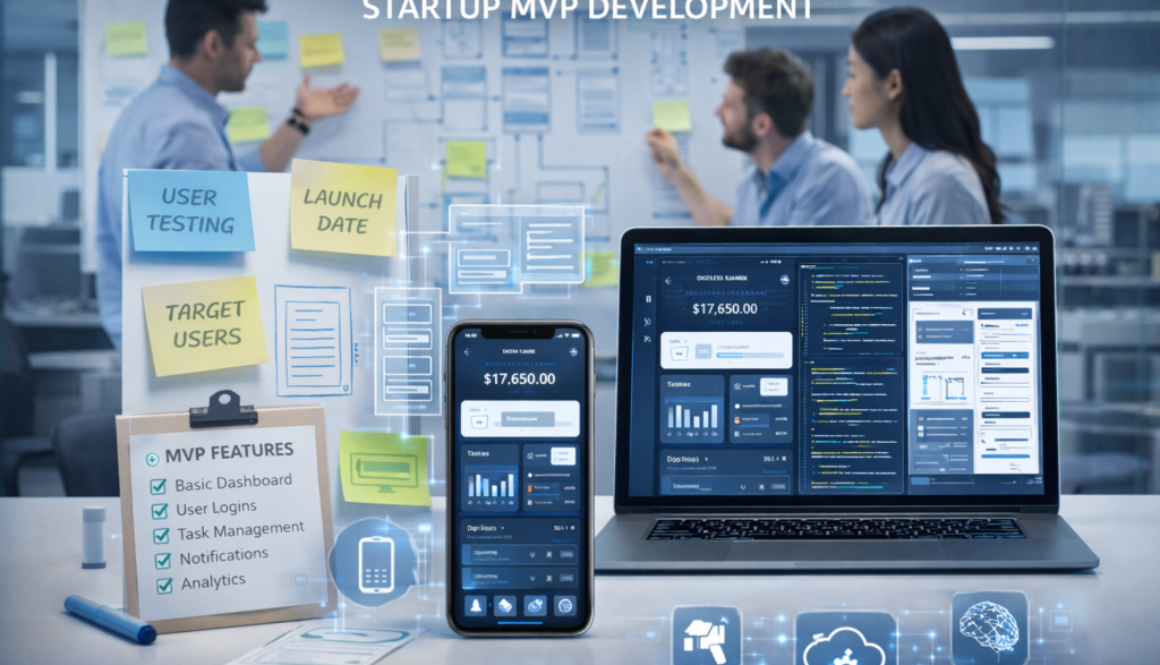
What Is an MVP? How to Build a Minimum Viable Product Fast
Introduction
Launching a product without testing the market is one of the biggest reasons startups fail. That’s where an MVP — Minimum Viable Product — comes in.
An MVP allows businesses to test ideas quickly, reduce risk, save money, and learn from real users before investing heavily in full-scale development.
In this guide, Sprocket Technology explains:
- What an MVP really is
- Why it’s essential
- How to build an MVP fast — without cutting quality
What Is an MVP (Minimum Viable Product)?
A Minimum Viable Product (MVP) is the simplest version of a product that includes only the core features needed to solve a specific problem and deliver value to early users.
An MVP is NOT:
❌ A half-built product
❌ A low-quality solution
❌ A final version
An MVP IS:
✔ Functional
✔ User-tested
✔ Scalable
✔ Feedback-driven
Why MVPs Are Critical for Startups & Businesses
🔹 1. Faster Time to Market
Get your idea in front of real users quickly.
🔹 2. Lower Development Costs
Avoid spending on unnecessary features.
🔹 3. Real User Feedback
Make data-driven decisions instead of assumptions.
🔹 4. Reduced Risk
Validate your idea before full investment.
🔹 5. Investor Attraction
Investors prefer proven concepts with real traction.
Examples of Famous MVPs
📌 Facebook – Simple social profiles for college students
📌 Uber – Basic ride-request app
📌 Airbnb – Simple website listing rooms
Each started small and scaled fast.
MVP vs Full Product
| Feature | MVP | Full Product |
| Core Functionality | ✅ | ✅ |
| Advanced Features | ❌ | ✅ |
| Speed to Market | Fast | Slower |
| Cost | Low | High |
| User Feedback | Early | Continuous |
Step-by-Step: How to Build an MVP Fast
1️⃣ Identify the Core Problem
Ask:
- What problem are we solving?
- Who is it for?
- Why does it matter?
🎯 Focus on ONE problem.
2️⃣ Define Must-Have Features Only
Use the MoSCoW Method:
- Must have
- Should have
- Could have
- Won’t have (for now)
3️⃣ Choose the Right Technology
To move fast:
- Use cross-platform frameworks (Flutter, React Native)
- Use scalable backend systems
- Avoid over-engineering
4️⃣ Design a Simple UI/UX
- Clean interface
- Easy navigation
- User-friendly flows
Good design improves adoption even at MVP stage.
5️⃣ Build, Test, Improve
- Build quickly
- Test with real users
- Collect feedback
- Iterate fast
This cycle is the heart of MVP success.
How Long Does It Take to Build an MVP?
| MVP Type | Timeline |
| Simple MVP | 2–4 weeks |
| Medium MVP | 1–2 months |
| Complex MVP | 3 months |
Common MVP Mistakes to Avoid
❌ Building too many features
❌ Ignoring user feedback
❌ Over-designing
❌ Skipping market research
❌ Delaying launch
How Sprocket Technology Builds MVPs That Scale
At Sprocket Technology, we:
✔ Help define your MVP strategy
✔ Build fast & scalable products
✔ Focus on user validation
✔ Prepare for future growth
✔ Support post-launch iterations
📩 From idea to MVP — fast, smart, and scalable.
Conclusion
An MVP is the smartest way to launch a product in today’s competitive market. It allows you to test, learn, and grow without unnecessary risk.
🚀 Build lean. Launch fast. Scale wisely.